8 Brutal Truths From the Study Where AI Scored 100% and CPAs Scored 37% in 2026 (Accountants, Read This)
The AI finished in 10 minutes. The humans took 3 hours. And the researchers almost didn't publish the results.
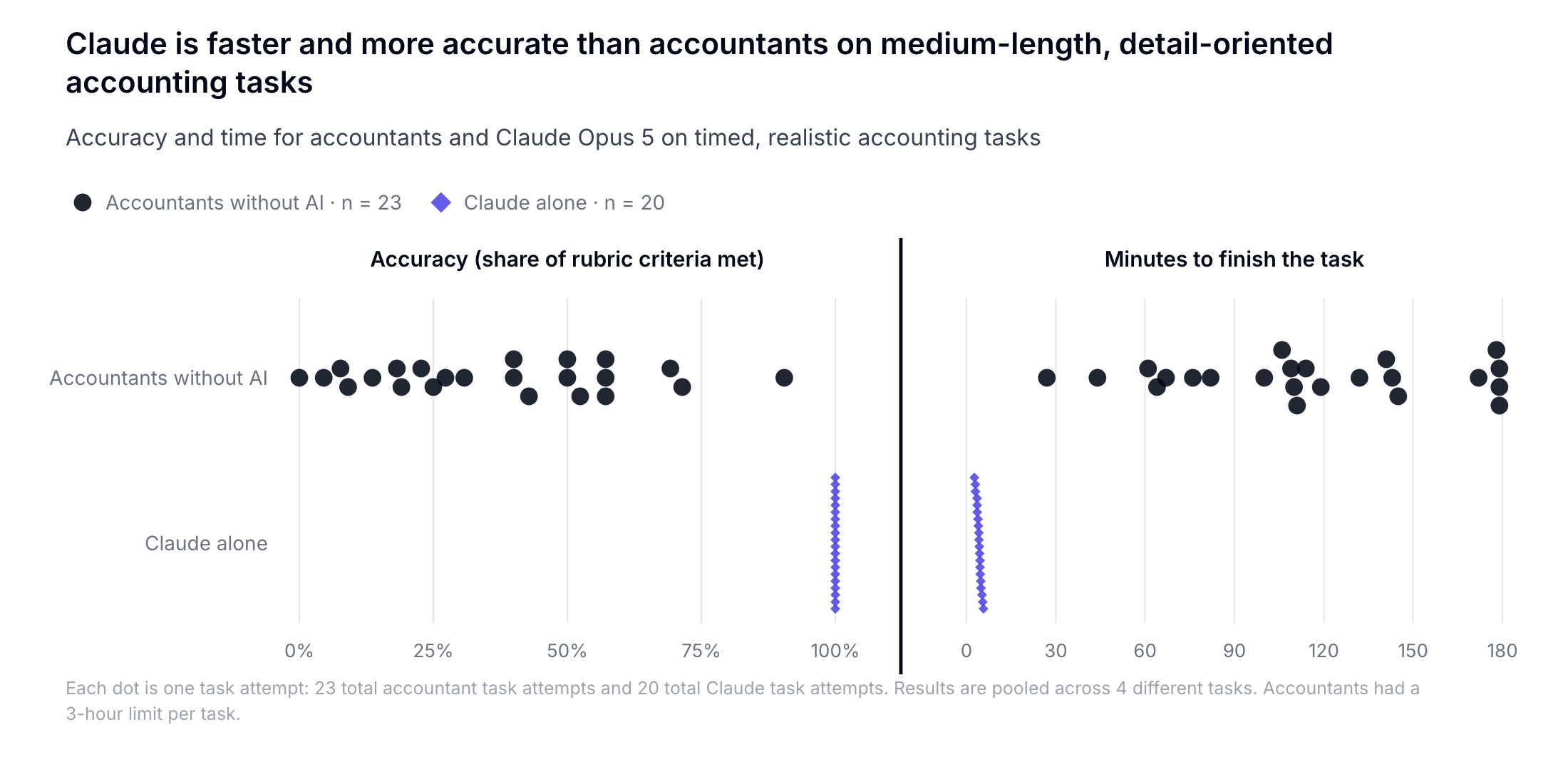 The dot plot that started the panic. Accountant accuracy ranged from 0% to about 90%. Claude Opus 5 hit 100% on all 20 attempts. Image: Mercor
Let's stop pretending "AI can't do real professional work" is still a defensible sentence.
Here's the uncomfortable truth: Mercor hired 12 licensed CPAs, gave them realistic month-end accounting scenarios, and the humans averaged 37% accuracy. Claude Opus 5 scored 100% on the same tasks, finished each one in under 10 minutes, and cost 49 times less per task. The researchers admitted they considered not publishing these results for fear of misinterpretation. They published anyway.
This article is not about accountants being replaced. It is about the most expensive sentence in business right now: "let's have a human double-check it."
1. The setup was as fair as studies get
- Mercor, an AI recruiting firm, hired 12 junior accountants, all licensed CPAs averaging 5.5 years of experience.
- Each accountant completed four realistic month-end close scenarios: dig through a company's working files, find the right numbers, do the math, deliver a table.
- The tasks came from APEX-Accounting, Mercor's benchmark built with the finance platform Ramp: 160 tasks across 10 simulated companies, authored by 42 accounting experts with a median 11 years of experience.
The so what: this was not a rigged demo. These were real accountants doing real-shaped work.
 A CPA at work. Twelve of them averaged 37% on the same tasks Claude Opus 5 aced. Photo via leaniar.com
(Source: Mercor)
2. The scoreboard: 100% vs 37%
- Human accountants averaged 37% accuracy. Individual scores ranged from a brutal 0% to nearly 90%.
- Claude Opus 5 scored a perfect 100% across all 20 reported attempts.
- The study is titled, without flinching, "Human Baselines for Benchmarks: AI Now Outperforms Junior Accountants."
The so what: the best human in the study still lost to the machine.
(Source: Mercor)
3. The speed gap is somehow worse than the accuracy gap
- Most human accountants took between 30 and 180 minutes per scenario.
- Claude Opus 5 finished every single task in under 10 minutes.
- That is not a marginal improvement. That is a different species of worker.
The so what: the AI is not just better at the task. It does a morning's work before your coffee cools.
(Source: Asianet Newsable)
4. The money gap: 49 times cheaper
- Comparing cost per task criterion, Claude Opus 5 cost $0.21. The accountants cost $10.35, based on the US median accountant wage.
- That makes the frontier model more than an order of magnitude cheaper than the human, per Mercor's own math.
- Mercor's blunt summary: "Models are also less expensive." Yes. Forty-nine times less expensive.
When the better worker is also 49x cheaper, the conversation stops being about technology and starts being about payroll.
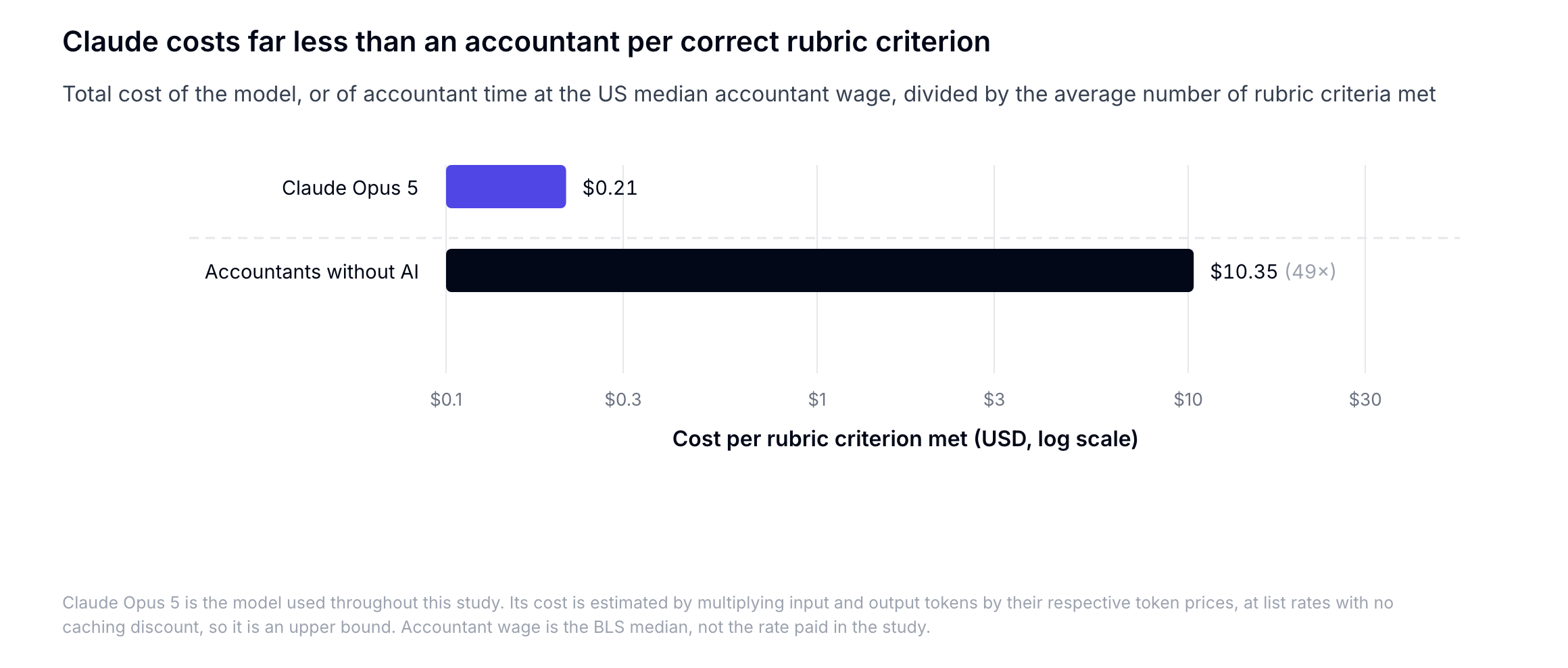 The money chart. Same bar, 49 times shorter. Image: Mercor
(Source: Mercor)
5. Eighteen months ago, the AI was losing. Then the graph went vertical.
- Just 18 months ago, the best AI models fell short of the average accountant's 37% score.
- GPT-4o scored near 0% on these tasks. OpenAI o3 passed the accountant average in spring 2025. GPT-5 reached about 69%.
- Now Opus 5 and other recent frontier models score at or near 100%. Some budget and open-weight models, like Qwen3.5-122B, still score below the accountant line.
The so what: the "AI can't do this" argument had an 18-month expiration date, and it just expired.
(Source: Mercor)
6. The caveat they almost buried (read this before you panic)
- Mercor is honest about it: the tasks tested what AI is best at, being detail-oriented, searching through files, and following instructions very closely.
- The setting stripped out much of the actual job: no coworkers to ask, no accumulated client context, no client communication.
- The tasks were originally designed to stump models, so they evolved into trap-laden puzzles where one overlooked number tanks your score. As one task author put it, "the traps [hidden in the task] are realistic, and the conditions and the scoring are what drove the results."
The so what: the AI won at a game shaped like AI's strengths. The whole job is a bigger game.
(Source: Mercor)
7. Capability is not reliability, and the gap is enormous
- On the full 160-task APEX benchmark, the current best (Opus 5.5 Max) meets 61.8% of evaluation criteria on average.
- Correct at least once in eight attempts: 21.5%. Correct on all eight attempts: 2.6%.
- Accounting work has to be repeatedly correct, not correct once. A model that nails the trial balance one time in five is not a junior accountant. It is a very fast colleague you would have to check every single time, which is not a colleague. It is a workload.
The so what: "can it do this" and "can it do this every time" are different questions with very different answers.
 Calculator over the charts. The surviving skill is checking the machine's work. Photo via nigelbutler.co.uk
(Source: kingy.ai, dataist.ai)
8. Elon Musk noticed, which tells you how loud this is
- Elon Musk shared the study on X, reacting: "Superintelligence, formerly known as AI, is now acing accounting exams."
- When the world's loudest technologist amplifies your benchmark, the benchmark stops being a research artifact and starts being a boardroom slide.
- Expect this chart in approximately every enterprise AI pitch deck for the next six months.
The so what: the study's real impact is not the numbers. It is who is now quoting them.
(Source: Asianet Newsable)
How to start
If you are an accountant, stop competing on the structured, detail-oriented tasks. The study says it plainly: the future value is in client communication, asking the right questions, and building tacit context. That is the part the benchmark could not even measure.
If you are a founder, run your own version of this test on your team's most repetitive workflows. Pick the task, set the rubric, time your people, then time the model. The numbers will make your roadmap obvious.
If you are an employee anywhere near spreadsheets, learn to be the person who checks the AI's work rather than the person the AI's work replaces. I have my Meta Muse, Petra, do the first pass on my structured research now, and I spend my time on the judgment calls. It is a better division of labor than my ego initially admitted.
The real pattern
Every profession has a structured core that looks like judgment but is actually just careful instruction-following, and AI is eating those cores in order of how well-defined they are. The survivors will not be the people who were best at the core. They will be the people who were already doing the messy, human, unmeasurable parts on the side.
Final thoughts
Mercor almost didn't publish this. Think about what that means: the results were so stark that the researchers feared we would misread them. We probably will anyway.
But the honest read is not "accountants are finished." It is narrower and scarier: the parts of the job that are just careful, fast, correct work now belong to the machine, and they cost $0.21. Everything else, the talking, the trusting, the knowing your client's business better than they do, just became the entire job.
Yes, AI helped write this. It did the typing. I gave the ideas and I did the editing and orchestrating.
If this saved you money or taught you something, buy me a coffee. It keeps the articles coming.
Follow along. Clap if it earned it.