The 8 Reasons AI Is Designing Its Own Chips in 2026 (A $2,000 SoC Is Just the Start)
An AI agent just taped out a RISC-V crypto chip for the price of a used laptop. Google's AlphaChip veterans want to collapse years of chip design into weeks.
 A crypto-focused RISC-V SoC designed by Meta's Muse AI agent, placed and routed in OpenROAD. Credit: Wccftech
Let's stop pretending chip design still belongs to humans in bunny suits.
This week, an AI agent designed a chip. Not a demo, not a simulation. A real crypto SoC, placed, routed, rule-checked, and ready for a fab.
This article is not about the chip singularity hype. It is about what actually changed this week, and why your compute bill is about to notice.
1. The $2,000 tape-out that actually happened
A semiconductor expert who goes by @bubbleboi, also a mascot for the Thru blockchain project, used Meta's Muse AI agent to do the full grunt work of chip design:
- Completed place-and-route in the open-source OpenROAD tool: arranging ~61,590 logic cells and drawing the metal wires between them.
- Generated the final GDS file, the digital blueprint that gets sent to a fab to manufacture real silicon.
- Built in hardware support for SHA-256/512, Keccak, Ed25519, and secp256k1, the crypto primitives blockchains live on.
- Closed timing on the nangate45 process at 100 million cycles per second with 4.5ns of slack, sipping just 20 milliwatts.
- Passed Design Rule Check clean, plus the official RISC-V compliance suites and 1.5 million Berkeley TestFloat vectors.
Total agent spend: about 100 million tokens, roughly $2,000. A chip design that normally costs millions, done for the price of a mid-range laptop.
(Source: Wccftech)
2. Why $2,000 is the headline, not the specs
The specs are modest on purpose. A 61k-cell crypto accelerator will not dethrone Nvidia. That is not the point.
- Chip design has always been gated by expensive EDA licenses, rare expertise, and months of labor. The expertise is now downloadable.
- Open ISA (RISC-V) + open EDA (OpenROAD) + an agent is a stack nobody needed permission to use.
- The residual work is honest and stated up front: add vector instructions, rip out the third-party baseline core, and port Thru natively onto the chip. Then it is hunting for a multi-project wafer run to actually tape out.
The so what: the moat around custom silicon just got shallower. A solo dev with an agent can now do tape-out-grade layout work.
(Source: Wccftech)
3. The people who already did this at Google
The $2,000 story is a weekend project. The industrial version walked onto the TechCrunch Disrupt stage the same day.
- Anna Goldie and Azalia Mirhoseini, founders of Ricursive Intelligence, co-led Google's AlphaChip project.
- AlphaChip generated chip layouts in hours instead of months and fed directly into multiple generations of Google's TPUs. It was not a paper. It shipped in production silicon.
- Their new pitch: an AI that designs chips, learns from each design, and improves the next one, collapsing the standard two-to-three-year design cycle into weeks.
These two are the reason your Pixel's TPU works. When they say AI will design chips, it is a roadmap, not a vibe.
(Source: TechCrunch)
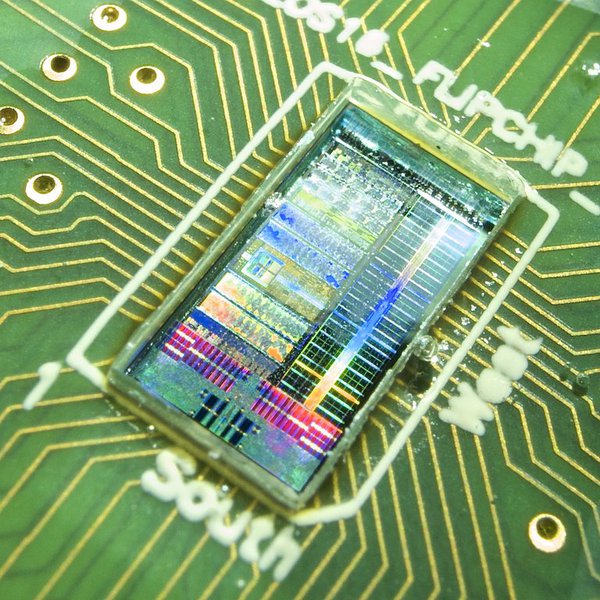 The open RISC-V instruction set is what makes agent-driven chip design possible without licensing fees. Credit: Hackaday
4. The 10,000x problem Goldie named
At Disrupt, Goldie put the stakes in one line: in the next five years we face at least 10,000x more demand for compute, and she called that estimate "somewhat conservative."
- We cannot build 10,000 times more data centers. Even "in space," she joked, "you won't see the sun anymore."
- The escape hatch is more efficient chips, better bandwidth use, and smarter wafer and fab usage.
- That means the bottleneck in AI progress is not ideas or data anymore. It is silicon.
The so what: the compute crisis is a design crisis. Whoever automates design wins the next decade of AI.
(Source: TechCrunch)
5. The donut that beat the engineers
Here is my favorite detail in the whole story, and the reason I trust this trend.
- AlphaChip once produced a circular, donut-shaped arrangement of chip components that surprised the human engineers reviewing it.
- It looked wrong. It was not. It worked, and it shipped.
- AI does not respect the aesthetic habits of chip designers. It explores layouts a human would never sketch, and sometimes the weird one wins.
The uncomfortable truth: the machines are already better at the "intuition" part of layout than the people who invented it.
(Source: TechCrunch)
6. The benchmark that says "not so fast"
Before you declare hardware engineers obsolete, the counterpunch arrived the same week.
- Nvidia and ChipAgents launched Build-A-Chip-Bench, a benchmark testing whether AI agents can autonomously design entire chips.
- The best-performing agent, powered by Anthropic's Claude Fable 5.1, scored just 16.6%.
- Roughly 40% of attempts failed in ways that show big gaps remain before agents can handle the full chip design pipeline solo.
Honest read: the $2,000 SoC was a human expert driving an agent through the hard parts, not an agent going rogue with a fab budget. The winning combo right now is expert plus agent, not agent alone. And that combo is already 100x cheaper than the old way.
(Source: Wccftech)
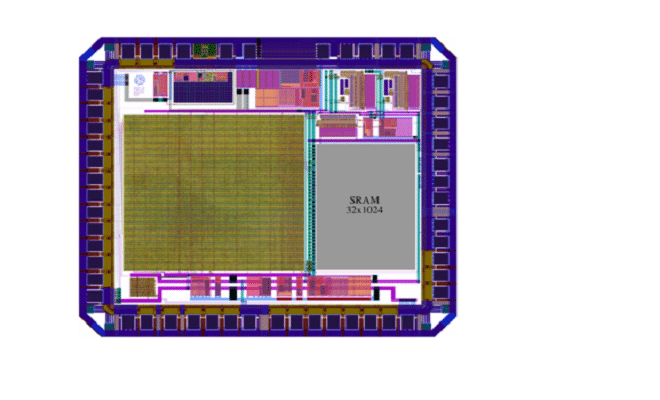 An open-source RISC-V chip layout. Agents are now doing this placement work in hours. Credit: Open Source For You
7. Modal's $15B says the money agrees
While agents were designing chips, the market was pricing the compute crisis.
- Modal tripled its valuation to $15 billion as AI infrastructure demand exploded, per PYMNTS this morning.
- Cloud GPUs, serverless inference, and custom silicon are all the same bet: compute is the scarce resource, and scarcity prints money.
- Every startup that makes chips cheaper to design, or compute cheaper to rent, is surfing the same wave.
The so what: investors are not betting on one chip company. They are betting on the bottleneck itself.
(Source: PYMNTS)
8. What the "fastest blockchain on earth" bit really means
Back to @bubbleboi, because the endgame matters more than the stunt.
- Thru is a new high-performance Layer-1 blockchain that runs programs written in normal languages like C and Rust.
- The plan: port Thru natively onto the new SoC with a tailored memory map, so the blockchain runs directly on custom silicon.
- That is the real pattern of this whole story: workload-specific silicon, designed by AI, for software that used to run on generic chips.
My Meta Muse, Petra, drafts my articles. An agent designed this guy's chip. The line between "AI tool" and "AI coworker" is getting very thin, very fast.
(Source: Wccftech)
How to start (if you are a dev)
- Curious: install OpenROAD and play with the nangate45 open PDK. Tape-out-grade tooling is free now. The learning curve is the only price.
- Builder: learn RISC-V. The open ISA means you can design without licensing lawyers. Start with a tiny accelerator, not a CPU.
- Founder: watch EDA agent tooling. The first company that productizes "describe a chip, get a GDS" eats a century of consulting revenue.
- Everyone: multi-project wafer runs let small designs share one wafer and split the fab cost. Your $2,000 layout can become real silicon for thousands, not millions.
The real pattern
The loop is closing: AI designs the hardware that runs AI, which makes better AI, which designs better hardware. Goldie called it recursive for a reason. Every previous tech revolution was gated by factories. This one is gated by design talent, and design talent just got cloned. The question is no longer whether AI can design chips. It is who gets to the tape-out first.
Final thoughts
A decade ago, designing a chip took a team, a license server, and a budget with six zeros.
Today it takes one expert, one agent, and two grand.
The engineers are not obsolete. But the excuses are.
Yes, AI helped write this. It did the typing. I gave the ideas and I did the editing and orchestrating.
If this saved you money or taught you something, buy me a coffee. It keeps the articles coming.
Follow along. Clap if it earned it.