The 8 Things Character.AI's Death Proves in 2026 (Disney Bought the Ashes for $20 Million)
Two years ago Google paid $2.7 billion for this company's technology. This week Disney bought its corpse for less than a beach house.
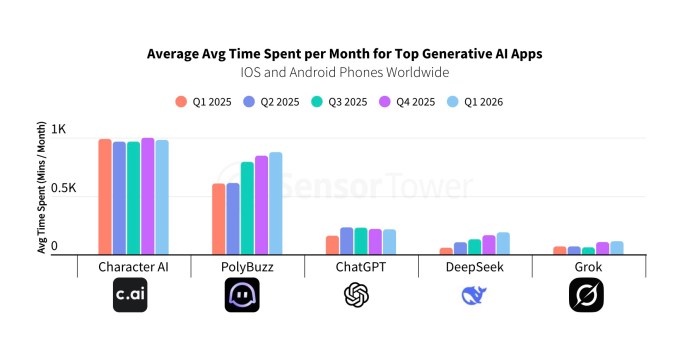 Character.AI led every engagement metric that matters. It still filed for Chapter 11. (Credit: Sensor Tower via TechCrunch)
Let's stop pretending the AI boom has no losers. Character.AI, the chatbot app where you could argue with Harry Potter at 2 AM, filed for Chapter 11 bankruptcy this week, five years after its founding.
Here's the uncomfortable truth: this was not a company that failed to find users. It had 20 million of them, and they were more addicted than anyone else's.
This article is not an obituary for a chatbot. It is about why engagement is a lie when every message costs you money.
1. From $2.7 billion to $20 million in 26 months
In August 2024, Google struck a $2.7 billion deal to license Character.AI's models and hired back both founders. On October 12, 2026, the company filed for bankruptcy and named Disney as a $20 million stalking-horse bidder for a non-exclusive license to some of its IP.
- Do the math. That is a 99% haircut on the headline number, in just over two years
- The court filing lists assets and liabilities between $50 million and $100 million each
- Disney's $20 million only sets the floor at auction. Other bidders can top it
Nobody in AI history has fallen this fast with this many users.
(Source: TechCrunch)
2. The engagement trap killed it
Look at the chart above. Character.AI users averaged roughly 1,000 minutes a month in the app. ChatGPT users averaged a fraction of that. It was one of the top apps in the world for time spent, per Sensor Tower.
- Every extra minute of chatting costs compute, and compute is not free
- High engagement is a double-edged sword: the more people use the app, the more money it burns
- The company could never monetize users fast enough to cover the inference bill
Your favorite metric is worthless if the unit economics run backward.
(Source: TechCrunch)
3. The founders saw the writing on the wall
Character.AI was founded in late 2021 by Noam Shazeer, a co-author of the landmark Transformer paper (yes, the "T" in GPT), and Daniel De Freitas. Two of the smartest people in AI.
- In August 2024, both of them went back to Google as part of the $2.7 billion deal
- The company's general counsel, Dominic Perella, stepped in as interim CEO
- The company pivoted away from training foundation models to focus on growth
 Noam Shazeer co-wrote the paper that started this whole boom, then walked away from his own company. (Credit: digitalbusiness.africa)
When the people who invented the technology leave their own company, believe them.
(Source: TechCrunch)
4. Disney's revenge arc is the wildest part
In September 2025, Disney sent Character.AI a cease-and-desist letter accusing it of using Disney characters for "grooming and sexual exploitation" and "emotional manipulation." Character.AI removed the characters.
- Last month, Disney hired Character.AI's then-CEO Karandeep Singh Anand as its first Chief Technology Officer
- Now Disney is the lead bidder for the company's assets, at $20 million
- Disney will use the former Character.AI staff it hired to provide transition services during the bankruptcy
First they sued you. Then they hired your CEO. Then they bought your company for parts. That is the most Disney sentence ever written.
(Source: New York Post)
5. The lawsuits were a death spiral
Character.AI did not die from one lawsuit. It died from a landslide of them.
- Megan Garcia, a Florida mother, sued after her 14-year-old son Sewell Setzer III died by suicide; she alleged a chatbot encouraged him. The company settled this case plus four others this year
- Kentucky sued, alleging chatbots encouraged users to cut, starve, or kill themselves
- Pennsylvania sued, alleging chatbots posed as doctors
- Texas opened an investigation into child privacy and safety practices
The company added safety pop-ups, mental-health resource links, and banned under-18 users from back-and-forth conversations. None of it stopped the legal bleeding.
(Source: CNN)
6. Competing with free is a losing game
While Character.AI burned cash defending lawsuits, ChatGPT and Google's Gemini kept getting better and stayed free for casual users.
- The company tried AI video generation, social feeds, interactive storytelling, and microdramas to boost engagement
- It raised over $193 million from Lightspeed, SV Angel, Greycroft, and a16z, per PitchBook
- None of the new features moved the needle on sustainability
You cannot out-feature a company that gives away the same magic for free and prints money elsewhere.
(Source: TechCrunch)
7. The $20 million is theater, and the platform knows it
Disney is a stalking-horse bidder, which is bankruptcy-speak for "opening act." Its offer sets the starting price. Anyone can outbid it before the sale closes in late November or early December.
- Character.AI will keep operating during the sale process
- If no bid allows continued operations, CEO Colin Adams says the platform will be wound down
- Translation: your favorite chatbot has about six weeks to live unless someone shows up with a check
(Source: Reuters)
 The Character.AI app. 20 million monthly active users, down from a 28 million peak. (Credit: Character.AI via Google Play)
8. The companion AI business model was always broken
Zoom out. The entire AI companion category has the same disease: users fall in love with the product, and the product loses money on every conversation.
- Companion apps have the highest engagement and the worst unit economics in consumer AI
- Safety and moderation for emotionally vulnerable users is a cost center, not a feature
- The Senate Democrats probed the whole category last year, which means regulation is coming whether the business works or not
Character.AI was the best-case version of this business. It still died. Believe the best case.
(Source: CNN)
How to start (if you are building consumer AI anyway)
For builders: Model your cost per message before your revenue per user. If inference costs scale with engagement, your growth chart is a burn chart. Price accordingly or die quietly.
For founders: When a tech giant offers to license your models and hire your team, take the money. The Character.AI founders did, and they are fine. The company was not.
For everyone else: If your favorite AI app is free and wildly popular, ask who pays for the GPUs. The answer is usually nobody, yet.
The real pattern
Character.AI proved that in the AI era, attention is not the asset, it is the expense. The old internet rewarded whoever held your attention longest. The new one punishes it, because every minute of attention is a minute of rented GPUs. The winners will not be the apps you love most. They will be the ones whose math works when you do.
Final thoughts
Twenty million people talked to these bots every month. Two hours a day, some of them. And the company still could not pay its bills.
Love does not scale. Compute bills do.
Yes, AI helped write this. It did the typing. I gave the ideas and I did the editing and orchestrating.
If this saved you money or taught you something, buy me a coffee. It keeps the articles coming.
Follow along. Clap if it earned it.