The 9 Things OpenAI's Free GPT-6 Luna Does in 2026 (Your Chatbot Just Grew Buttons)
Paid users got it October 7. Free users got it October 8. The plain-text chatbot era ended in 24 hours.
 Free-tier ChatGPT is where most people will first meet GPT-6. Photo: Japanexperterna.se / Wikimedia Commons (CC BY-SA 2.0).
Everyone is treating this as a model upgrade. Almost no one is noticing what actually changed.
On October 7, OpenAI started pushing GPT-6 into ChatGPT along with a new Intelligent UI. Paid tiers (Plus, Pro, Business, Enterprise) got GPT-6 Sol on October 7. Free and Go users started getting GPT-6 Luna on October 8. The chatbot stopped being a wall of text and started drawing buttons, charts, calculators, and bill splitters inside your answers.
This article is not a list of benchmark scores. It is about what happens when the most-used AI product on the internet changes what an answer looks like.
1. Free and Go users got their own model: GPT-6 Luna
GPT-6 is not one model under the hood. OpenAI split it: paid tiers run GPT-6 Sol, while Free and Go tiers run GPT-6 Luna. Both get the new Intelligent UI.
- Luna is the faster, lighter model tuned for everyday chat.
- Sol is the stronger model for paying customers.
- Both were already circulating as names before this week; what changed is that they are now what ChatGPT runs by default for everyone.
Free users got the headline feature, not a watered-down demo.
(Source: temperature2)
2. The model now picks the answer format
Intelligent UI is not a theme or a plugin. It is a behavior baked into how GPT-6 formats its own output. The model evaluates your question and decides whether a text response, a visual layout, or an interactive component serves it best. Nobody flips a switch; the choice happens automatically.
- OpenAI built a library of native, streamable components with a compiler that renders the interface while the model generates it.
- The layout gets drawn line by line as the answer streams, not bolted on after.
- The routing logic sits inside Sol and Luna themselves, part of the model's native output formatting.
You no longer ask for a chart. The chatbot decides you need one.
(Source: Tech Insider)
3. Calculators, bill splitters, maps, and games
The examples OpenAI chose to publicize tell you exactly who this is for. Ask a recipe question and you get a widget with adjustable serving sizes instead of a bullet list. Ask it to split a dinner bill and you get an interactive bill splitter. Other demos: airplane wing lift diagrams, bicycle mechanics, multi-day hiking excursion maps, a personal savings calculator.
- Tappable buttons, forms, charts, checklists, comparison layouts, interactive diagrams.
- Even small games you can play inside the conversation.
- None of it requires leaving the chat window or opening another app.
The chat window is becoming a little app store.
(Source: AI Weekly)
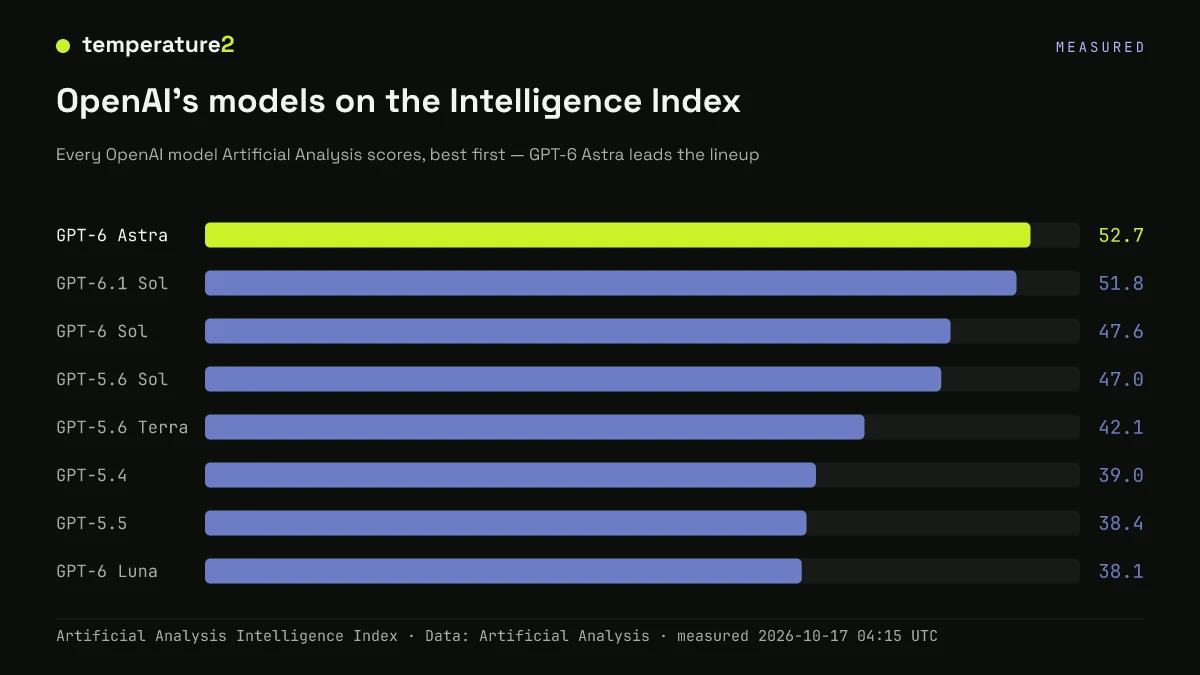 Independent benchmark scores across the GPT-6 lineup, with Astra leading. Chart: Artificial Analysis.
4. The "44% faster" claim, read carefully
OpenAI says GPT-6 Instant answers web-search questions 44% sooner on average than GPT-5.6 Instant. Sounds enormous. Here is the fine print: that measures time-to-first-token only. The model starts rendering while it is still completing its reasoning pass.
- Faster to start, not necessarily faster to finish.
- These are OpenAI's own figures, not independent benchmarks.
- The speed matters more here than for a plain model upgrade, because Intelligent UI adds rendering work on top of generation. A slower model with a fancier interface would just feel laggier.
Read the speedup as "it starts talking sooner," and you'll never be disappointed.
(Source: AI Weekly)
5. Pro thinkers get the raw brain but no buttons
Here is the odd trade-off nobody is talking about. The separate Pro reasoning setting stays on GPT-6 Astra, and Astra does not support Intelligent UI. So the most computationally expensive reasoning mode in ChatGPT trades the entire new visual layer for raw reasoning depth.
- Astra is aimed at coding, research, computer use, and complex multistep work.
- Access is limited to selected organizations; it is not generally available.
- Intelligent UI covers the Instant through Extra High reasoning settings, but the top tier is a text-only zone.
Pay the most, get the least visual fun.
(Source: Tech Insider)
6. Only the Chat tab; Work and Codex are untouched
The new layer does not touch ChatGPT Work or Codex, which stayed on their September builds. OpenAI is testing the riskiest, highest-volume surface first: the plain consumer chat box hundreds of millions of people use every day.
- A malformed button in a casual chat is a shrug. A broken widget in a professional workflow is a liability.
- The professional surfaces get stability; the consumer surface gets the experiment.
Your side project gets the experiment; your work tool gets stability.
(Source: DataNorth)
7. You can turn the pictures down
Don't like it? There is a layout toggle on the web client that flips the answers back to plain text. OpenAI's own product manager, Aarush Selvan, admitted to TechCrunch that "ChatGPT has predominantly been a text-based interface," and that the company wants the most helpful answers, not just text ones.
- The toggle is the most honest metric in this whole launch.
- If most people flip back to plain text, Intelligent UI becomes a party trick for bill splitting.
- If they don't, OpenAI just redefined what "a chat answer" looks like, and every competitor shipping plain paragraphs starts looking dated.
Watch the toggle. It is the only review that matters.
(Source: AI Weekly)
 The ChatGPT logo. Image: BrightWork.
8. The security footnote nobody read
The safety documents shipped alongside the update contain a quiet detail: Sol scores 97.13% robustness against indirect prompt injections, Luna scores 95.80%. Factuality improved on both, with room left on the model's judgment of when a widget helps more than plain prose.
- The free model is slightly easier to trick than the paid one. Note the gap.
- A fancier interface is also a bigger attack surface: every widget is a new place for injected instructions to hide.
The free model is slightly easier to fool. That is the price of free.
(Source: PC-Tablet)
9. Why free users got it in 24 hours
Past OpenAI rollouts took paid-to-free features weeks or months to reach parity. This one took a day. OpenAI's Help Center schedule shows paid tiers on October 7 and free tiers on October 8, and the rollout is still reaching accounts through this week.
- OpenAI says more than 1.2 billion people use ChatGPT each week. The free tier is the largest segment by far.
- Shipping the new interface to free users within 24 hours is not generosity; it is distribution as strategy.
- And remember the honest part: generous free tiers are how you buy the audience. OpenAI has already tested ads in ChatGPT and has said advertising could eventually be a huge share of its revenue. The interface is the product. You are the inventory.
Nobody gives away the future for free. They give away the on-ramp.
How to start: five prompts to try this week
-
"Split our dinner bill four ways with different tip percentages."
-
"Build me a calculator to explore how my savings could grow."
-
"Compare these two laptops side by side."
-
"Show me how an airplane wing generates lift."
-
"Turn this recipe into a widget with adjustable serving sizes."
Then flip the layout toggle off and on, and notice which answers you actually prefer as text. Builders, pay attention: generative UI is coming to your product next, and your users' reactions to ChatGPT's widgets are free market research.
The model choosing the format is the feature. Everything else is decoration.
The real pattern
The chatbot stopped being a place you type and started being a place things happen. Whoever controls the shape of the answer controls what the user believes is possible, and this week OpenAI decided the answer is no longer a paragraph. Every chatbot still shipping plain text just got a deadline it did not ask for.
Final thoughts
A wall of text was always a limitation pretending to be a format. The interesting question is not whether buttons are better than paragraphs. It is what you stop noticing once the machine starts deciding how you should see the answer.
Yes, AI helped write this. It did the typing. I gave the ideas and I did the editing and orchestrating.
If this saved you money or taught you something, buy me a coffee. It keeps the articles coming.
Follow along. Clap if it earned it.